

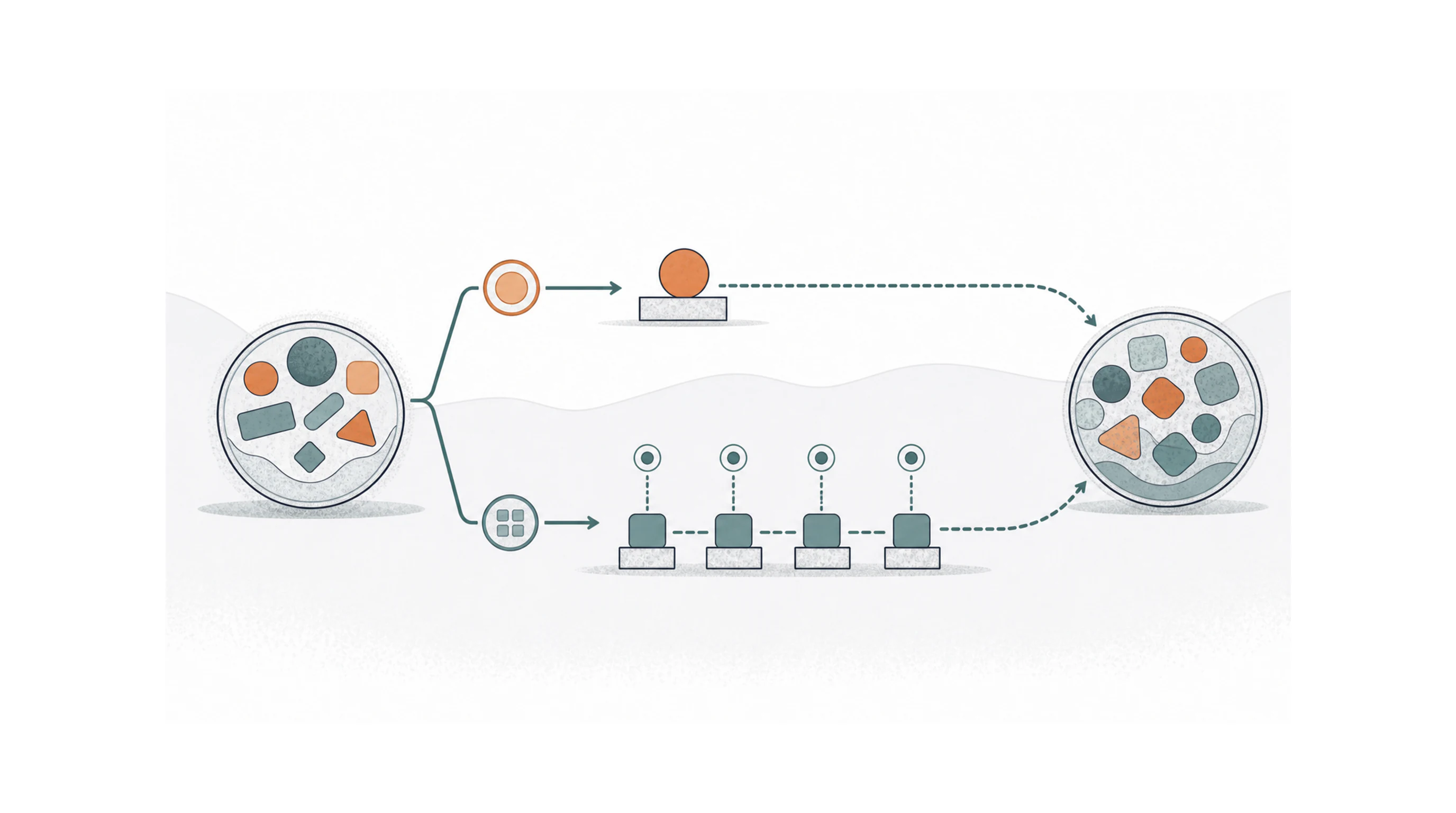
If you already have money available to invest, a lump sum puts the full balance to work immediately while dollar-cost averaging spreads purchases across a schedule. The choice is a tradeoff between time invested, a defined entry schedule, and your ability to tolerate a decline. It is not a guarantee about which path will win.
This guide is about deploying money you already have available, such as a cash balance from a maturing deposit or an account transfer. That is different from investing each paycheck when you receive income. With paycheck investing, the money is not available for investment before it arrives, so there may be no choice between a lump sum and a delayed schedule.
This is general U.S.-oriented financial education, not individualized financial, tax, or investment advice. Investments can lose value. Consider your goals, time horizon, emergency reserve, account rules, and risk capacity before acting.
The two approaches
A lump-sum approach invests the available amount according to the target allocation as soon as practical. Dollar-cost averaging, or DCA, divides that existing amount into scheduled purchases, such as equal weekly or monthly installments. The schedule should be written down before the first purchase so that it is an implementation rule rather than a series of emotional market calls.
Neither label describes the asset allocation itself. You can use either approach with a diversified portfolio, a single fund, or another investment, but diversification and suitability are separate questions. A purchase schedule cannot make an unsuitable investment suitable.
What changes when cash is already available?
The central tradeoff is time in the market versus time in cash. A lump sum gives the entire balance more time exposed to the chosen investments. During that exposure, prices can rise or fall. DCA keeps part of the balance in cash or another holding while the schedule is incomplete. If a decline occurs during the schedule, the portion not yet invested is not exposed to that decline, while amounts already invested can still lose value. If prices rise, holding part of the money in cash can mean missing some gains.
A preset schedule may reduce opportunities for impulsive timing decisions, but it does not eliminate behavioral risk. A person who would otherwise hold the cash indefinitely may find a written schedule easier to follow than a one-day decision. The cost is not just a possible return difference. A schedule can add transfer work, create more opportunities to change the plan, and leave the portfolio underinvested for longer. A lump sum can be operationally simpler, but a sharp decline immediately afterward may test the investor’s ability to stay invested.
For a bounded illustration of this available-cash decision, try the DCA Calculator after writing down your deployment period and monthly cadence.
Keep paycheck investing separate
Regular paycheck investing puts money to work as it becomes available. It is different from deliberately holding an already-available balance in cash and deploying it later. You may still choose payroll deferral percentages, account types, and an investment allocation, but do not describe those future contributions as a DCA schedule for cash already in hand. Keeping the definitions separate prevents an apples-to-oranges comparison.
Decision factors to document
Before choosing a schedule, write down:
- Purpose and horizon: When might you need the money, and is the horizon long enough for market losses to be possible without forcing a sale?
- Emergency liquidity: Keep a separate reserve for near-term needs. Do not make a market-entry schedule with money needed for bills or known expenses.
- Risk capacity and behavior: Could you continue the plan after a material decline? A theoretically attractive plan that you abandon can be worse than a simpler plan you can follow.
- Allocation: Decide the target mix before comparing entry schedules. Rebalancing needs and concentration risk are not solved by installments.
- Implementation: Set dates, amounts, account, and what happens if a purchase fails. Avoid changing the rules in response to headlines.
- Opportunity cost: Ask what the uninvested portion will earn, whether it is protected, and whether transferring it has restrictions.
Costs, account rules, and taxes
Check expense ratios, transaction fees, bid-ask spreads, account fees, and any minimums. More installments can mean more transactions or more chances to incur a fee. Some providers offer no-commission purchases, but fee policies change, so verify the current schedule for the account and fund. Taxes can also depend on the account and transaction.
In a taxable account, selling an investment can create a capital gain or loss. The tax result depends on cost basis, holding period, income, loss rules, and current law. Repeated purchases can create shares acquired on different dates or at different prices. The basis and identification of shares sold can affect reported gain or loss, while IRS identification rules, account defaults, and special rules for some funds may apply. Check the broker’s procedures or consult a tax professional. In a traditional 401(k) or IRA, contributions and distributions follow plan and tax rules. A transfer, rollover, or early distribution can have consequences that are not answered by the entry schedule. Confirm current IRS and plan rules rather than treating this article as tax guidance.
Illustrative arithmetic, not a forecast
Illustrative example: Assume $12,000 is already available, the investor chooses six equal monthly purchases, and ignore returns, taxes, fees, and interest on cash. Each purchase is $12,000 ÷ 6 = $2,000; after six purchases, $2,000 × 6 = $12,000. If the price is unchanged, both approaches purchase the same dollar amount. If prices move, the number of shares differs because each installment uses the then-current price. This arithmetic does not predict which approach will produce a higher balance.
If you use the Firebasis DCA calculator
The DCA Calculator can help explain how purchase timing and a chosen path affect a simplified illustration. It uses a deterministic sine-wave illustration with model version dca-deterministic-v1: the full balance is invested at the start for the lump-sum case, while equal monthly purchases are made at the start of each period for the DCA case. The deployment period is the selected number of months, and uninvested cash earns 0% while waiting. It is not based on historical data, probability, or Monte Carlo and should not be read as a forecast, expected-return estimate, or risk measurement. Change the inputs and record the assumptions; do not infer that one output establishes a generally superior strategy.
The calculator excludes taxes, fees, dividends, fund-specific behavior, account rules, and future paycheck contributions. Its sources and review date are shown in the methodology disclosure. Inputs stay in the browser for the calculator, which does not require an account or personal identifying information. The calculator is general U.S.-oriented financial education, not individualized financial, tax, or investment advice.
You can also compare compounding assumptions with the Compound Interest Calculator and inspect recurring-cost assumptions with the Fee Analyzer. Those tools simplify reality too. They do not determine suitability, taxes, or an appropriate allocation.
Sources and freshness
The linked sources below provide general investor education, fee information, and tax references. They do not determine an individual’s outcome. The official URLs and the claim-to-source mappings in the evidence packet were checked August 2, 2026. Recheck the FINRA and Investor.gov explanations, fund and brokerage fee schedules, and current IRS and plan rules before publication and whenever tax law, account rules, or the site’s calculator behavior changes. The next editorial review trigger is February 2, 2027, or earlier after a material source or calculator change.
Sources
- FINRA: Dollar-cost averaging
- Investor.gov: Dollar cost averaging
- Investor.gov: Asset allocation and diversification
- Investor.gov: Mutual fund and ETF fees and expenses
- IRS: Publication 550, Investment Income and Expenses
- IRS: Topic no. 409, capital gains and losses
- IRS: Tax on early distributions
- IRS: 401(k) resource guide
Frequently Asked Questions
Is dollar-cost averaging the same as investing each paycheck?
No. Investing each paycheck is usually a contribution-timing habit because the money becomes available over time. Dollar-cost averaging in this comparison means holding money that is already available and investing it in scheduled portions.
Does investing a lump sum guarantee a better result?
No. A lump sum has more time exposed to the market, but a decline soon after investing can produce a worse short-term experience. Neither approach guarantees a return or protects against loss.