

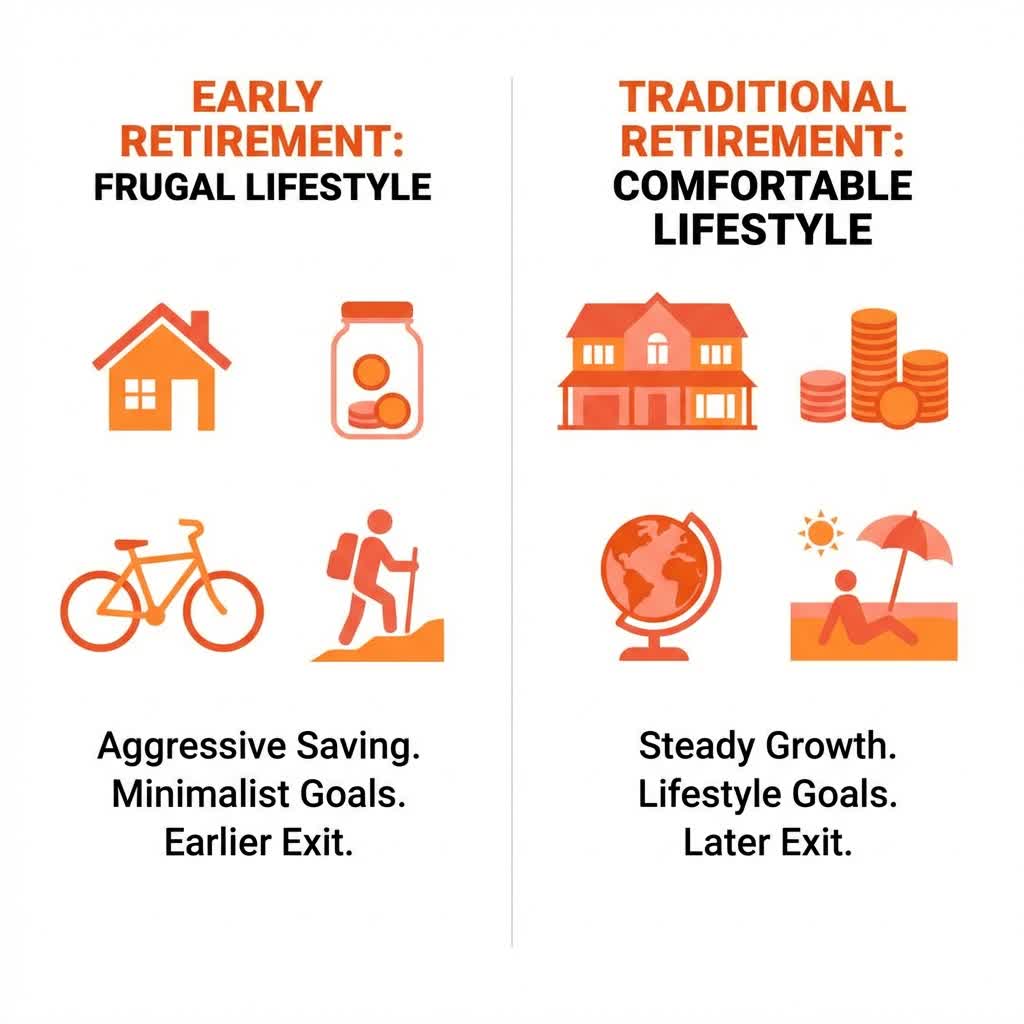
Lean, Fat, Coast, and Barista FIRE are informal planning labels, not official financial standards. Compare them using actual annual spending, required earned income, target age, withdrawal assumptions, health coverage, and margin for error.
The FIRE movement includes several ways to describe the relationship between work, spending, and invested assets. The labels can help start a conversation, but they do not replace a plan. There is no regulator-approved threshold that makes a household “Lean FIRE” or “Fat FIRE,” and a category that fits one region or family may not fit another.
This article is general U.S.-oriented financial education, not individualized financial or investment advice. Investment returns, inflation, taxes, health costs, and personal circumstances can change the result.
Lean FIRE
Lean FIRE generally means reaching financial independence with a comparatively low-spending lifestyle and a smaller target portfolio. The approach may emphasize modest housing, careful transportation choices, limited discretionary spending, and a willingness to adapt.
Potential advantages include a lower initial portfolio target and fewer years required to reach it. The tradeoff is less room for health expenses, housing changes, family support, travel, or sustained inflation. A lean plan should include irregular costs rather than treating the current monthly budget as permanent.
Ask:
- Does the budget include taxes, health coverage, home and vehicle replacement, and long-term care risk?
- Which expenses are genuinely optional?
- Could part-time work or a spending reduction absorb a market decline?
- Would the plan still be acceptable if the target date moved?
Fat FIRE
Fat FIRE generally describes financial independence designed to support higher discretionary spending and a larger cushion. Travel, an expensive location, larger housing costs, family assistance, or premium services may be part of the intended lifestyle.
A larger portfolio can create flexibility, but it does not provide “maximum security.” A high-spending plan remains exposed to taxes, investment losses, inflation, longevity, and changes in recurring commitments. A larger target can also require more working years, a higher income, or both.
Avoid defining Fat FIRE with a universal $100,000 spending cutoff. Use the household’s actual desired spending and local costs.
Coast FIRE
Coast FIRE means current invested assets are projected to grow to the desired portfolio by a later target age without additional retirement contributions. The person still needs income to cover present living expenses.
For example, someone may have enough invested at 40 that a stated return assumption projects the balance to reach a retirement target at 65. That does not mean the future value is guaranteed or that work can stop immediately. Fees, inflation, taxes, market returns, and the future spending target all affect the calculation.
Use the Retirement Savings Calculator to test more than one return and contribution scenario. A coast projection should be reviewed regularly, especially after a market decline or major spending change.
Barista FIRE
Barista FIRE generally combines a partially funded portfolio with continued part-time, flexible, or lower-intensity work. Earned income may cover some expenses and reduce withdrawals. Some people also hope to obtain employer health benefits.
Benefits are not guaranteed by the label. Eligibility, minimum hours, premiums, deductibles, networks, and plan quality are employer-specific. A robust plan should work with actual benefit documents and include a backup coverage option.
Barista FIRE can reduce early portfolio withdrawals, but it also depends on the continued ability and willingness to work. Model unemployment, illness, caregiving, and a lower-than-expected wage.
Compare the paths using numbers
| Path | Portfolio role | Earned-income assumption | Primary planning risk |
|---|---|---|---|
| Lean FIRE | Funds comparatively low spending now | Usually none | Small margin for unexpected costs |
| Fat FIRE | Funds higher spending now | Usually none | Larger target and high ongoing commitments |
| Coast FIRE | Expected to fund a later retirement | Covers current spending | Long-horizon return assumptions |
| Barista FIRE | Funds part of spending | Part-time or flexible work continues | Job and benefit availability |
Model one household across multiple paths
Suppose retirement spending is $60,000 per year before tax and dependable non-portfolio income is zero. At a 4% initial withdrawal assumption, the simple target is $1.5 million. At 3.5%, it is about $1.71 million. These are planning estimates, not guarantees.
A Lean scenario might reduce spending to $45,000. A Fat scenario might increase it to $90,000. A Barista scenario might assume $20,000 of earned income for several years. A Coast scenario would instead ask whether today’s balance can plausibly grow to the later target.
The Firebasis FIRE Calculator can compare spending and withdrawal assumptions. Test adverse and favorable cases rather than selecting the label that produces the earliest date.
Do not skip health coverage and Social Security
People retiring before 65 may use Marketplace or other coverage, and eligibility for financial assistance can depend on household income. Medicare generally begins around 65, subject to eligibility and enrollment rules. Part-time employer coverage must be verified with that employer.
Stopping work early can also change projected Social Security benefits. Use your actual earnings record and current estimates rather than copying someone else’s benefit assumption.
Choose a path that can adapt
A useful FIRE plan states:
- target annual spending in today’s dollars;
- expected earned and dependable non-portfolio income;
- target retirement age and planning horizon;
- withdrawal method and tax assumptions;
- health-coverage source before and after Medicare eligibility;
- actions available after a poor market sequence.
You can change categories over time. A Coast plan can become traditional FIRE after additional saving; a Fat target can become Lean after priorities change. The label should describe the numbers, not dictate them.
Sources
- Investor.gov: Saving and investing roadmap
- HealthCare.gov: Health coverage for retirees before Medicare
- Medicare.gov: Getting started with Medicare
- Social Security Administration: Benefit calculators
Sources reviewed July 29, 2026. Recheck current health-coverage and benefit rules when updating the plan.
Frequently Asked Questions
Is there an official dollar cutoff for Lean or Fat FIRE?
No. These are informal community labels. A spending level that feels lean in one household or location may feel comfortable in another, so define the actual annual budget and assumptions.
Does Coast FIRE mean I can stop working now?
Usually not. Coast FIRE means existing investments are projected to grow to a later retirement target without additional contributions. Current living expenses still need to be funded, and the projection depends on uncertain assumptions.