

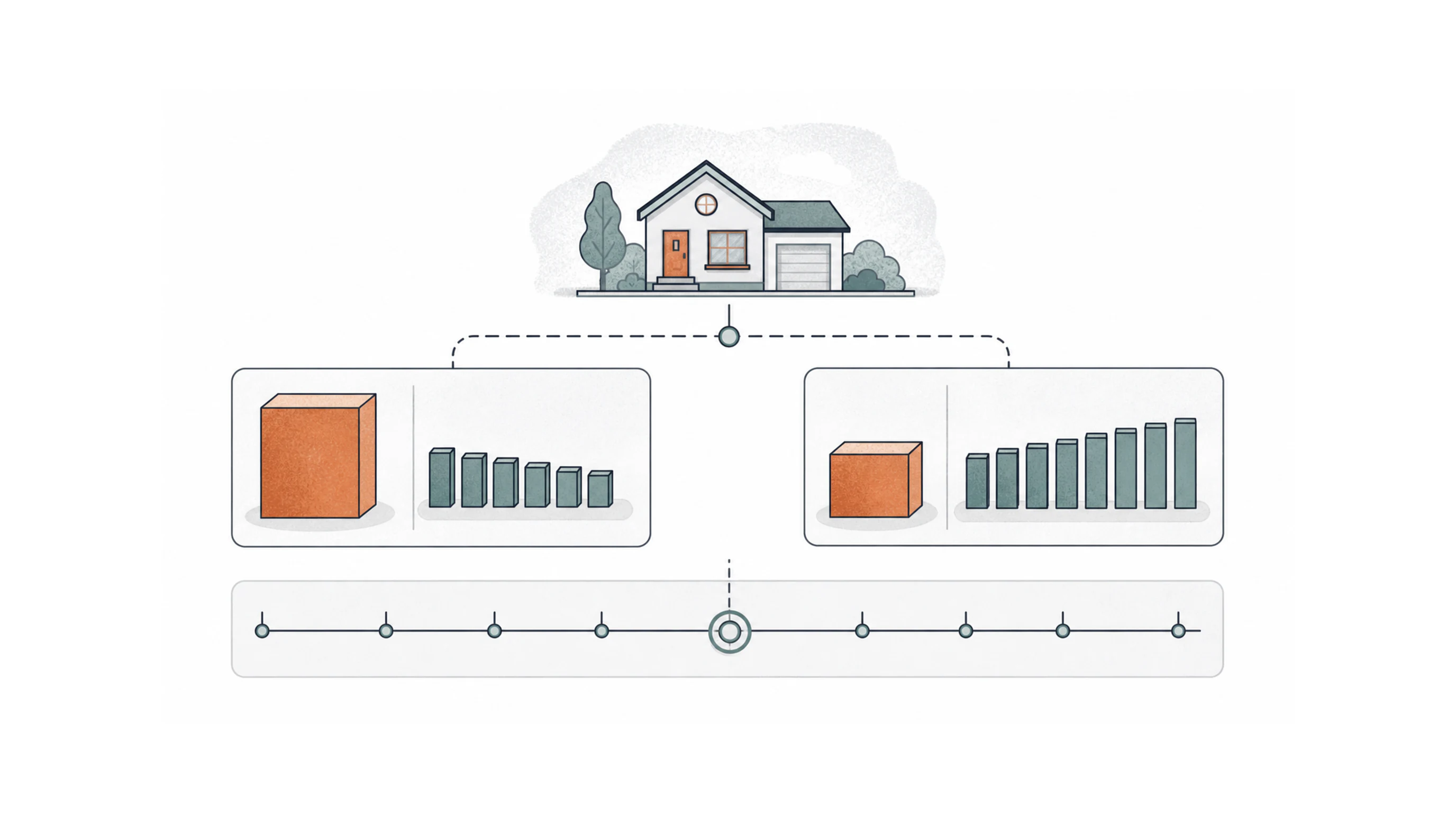
Discount points generally mean paying more at closing for a lower mortgage rate. Lender credits generally mean accepting a higher rate in exchange for help with upfront costs. A break-even calculation can screen the tradeoff, but it is not a complete loan-cost comparison or a recommendation.
This is general U.S.-oriented financial education, not individualized mortgage, tax, or legal advice. Loan pricing, disclosure treatment, taxes, and eligibility depend on the offer and the borrower’s circumstances. Compare the actual Loan Estimates and Closing Disclosures you receive.
Discount points and lender credits are different
A discount point is an upfront charge tied to the mortgage rate. One point equals 1% of the loan amount, but the rate change for a point is not universal. It can vary with the lender, loan type, and market conditions. Paying points may lower the payment for as long as the loan remains in place.
A lender credit works in the opposite direction. The lender applies a credit toward eligible closing costs, while the borrower accepts a rate or pricing tradeoff. The credit is not free money. Its value needs to be compared with the added payment and the time the loan is expected to remain outstanding.
For a useful comparison, hold the important terms constant: loan type, loan amount, term, property purpose, and other lender charges. Compare a zero-point offer, a points offer, and a lender-credit offer when the lender provides them on a comparable basis.
Start with the actual disclosures
The CFPB says points and lender credits appear on the Loan Estimate and Closing Disclosure. Use those documents rather than a generic example or a headline rate. Check:
- the amount of points or lender credits.
- the interest rate and whether it is fixed or adjustable.
- the projected principal-and-interest payment.
- other lender charges and credits.
- prepaid items and initial escrow, which may not be part of the points tradeoff.
- the loan term and any terms that could change the comparison.
Ask the lender to explain any difference between offers. A lower payment can result from a different loan term or other pricing change, not only from discount points.
The break-even screen
For a simple points comparison, use:
Break-even months = eligible incremental upfront cost / monthly principal-and-interest payment reduction
This is only a screening estimate. It omits or simplifies material items such as principal balance changes, other closing costs, prepaid items, escrow, taxes, insurance, loan-term differences, lender pricing, sale timing, and refinance timing. A borrower who sells or refinances before the screen is reached may not recover the upfront cost. A borrower who keeps the loan longer still needs to compare total costs and liquidity. Do not treat the result as a recommendation.
For lender credits, run the comparison in the other direction: identify the credit that reduces upfront costs, then compare the added payment and other terms with the zero-credit offer. A points calculation should not be relabeled as a lender-credit result.
One hypothetical example
The following example uses invented inputs for reproducibility. It is not a current-rate claim and is not presented as typical.
Assume:
- loan amount: $320,000.
- 1.25 discount points.
- zero-point rate: 6.75%.
- points-offer rate: 6.50%.
- 30-year fixed term.
- comparison limited to principal and interest.
The points cost is $320,000 x 1.25% = $4,000. Using standard fixed-payment amortization, the illustrative payment falls from about $2,075.51 to $2,022.62, a reduction of about $52.90 per month. The screening break-even is $4,000 / $52.90 = 75.6 months, or about 6.3 years.
Using the rounded monthly reduction, the simple net payment-minus-points-cost screen is approximately:
| Hypothetical holding period | Payment reduction | Less points cost | Simple screen |
|---|---|---|---|
| 3 years | $1,904 | $4,000 | -$2,096 |
| 7 years | $4,444 | $4,000 | $444 |
| 10 years | $6,348 | $4,000 | $2,348 |
This table does not include the loan balance, the time value of money, taxes, opportunity cost, other closing costs, prepaid items, escrow, sale or refinance costs, or differences in lender pricing. The arithmetic is a way to expose assumptions, not a verdict about which offer to accept.
Compare more than one holding period
If your timing is uncertain, compare at least three periods: the shortest plausible period, the longest plausible period, and the period you currently consider most likely. A sale, refinance, job change, or other event can change the outcome. Recalculate when the offer, loan term, points, credit, or expected timing changes.
A points offer may look better over a long holding period but worse if the loan is replaced soon. A lender-credit offer may preserve cash at closing but cost more through a higher payment. Neither tradeoff can be evaluated from the monthly payment alone.
Keep the screen tied to the actual offer
This guide does not link to a generic points calculator because rate reductions, tax treatment, lender pricing, and recommendation labels are not universal. If you use a calculator elsewhere, treat its output as a model rather than a lender quote, enter the exact offer terms, and confirm the result against the comparable Loan Estimate.
For a broader payment estimate, see the Mortgage Payment Calculator. The Mortgage Tools hub lists related mortgage scenarios. If your question is whether to pay down an existing mortgage or invest instead, the mortgage payoff and investing guide addresses that separate decision.
Before comparing offers
- Gather the Loan Estimates for the offers you are comparing.
- Confirm that the loan type, term, amount, and rate structure are comparable.
- Separate points and lender credits from other closing costs, prepaid items, and escrow.
- Record the exact upfront difference and the principal-and-interest payment difference.
- Test multiple holding periods, including an early sale or refinance scenario.
- Check how the result changes if the rate, points, credit, or timing changes.
- Ask the lender about terms you do not understand, and obtain tax guidance from a qualified professional if tax treatment is part of your decision.
A break-even period is useful when it makes the tradeoff visible. It is not a substitute for reading the disclosures, comparing like-for-like offers, and considering the cash you need to keep available.
Sources
Sources accessed August 2, 2026. Recheck official guidance and the borrower’s actual disclosures before publication or use.